

[ad_1]
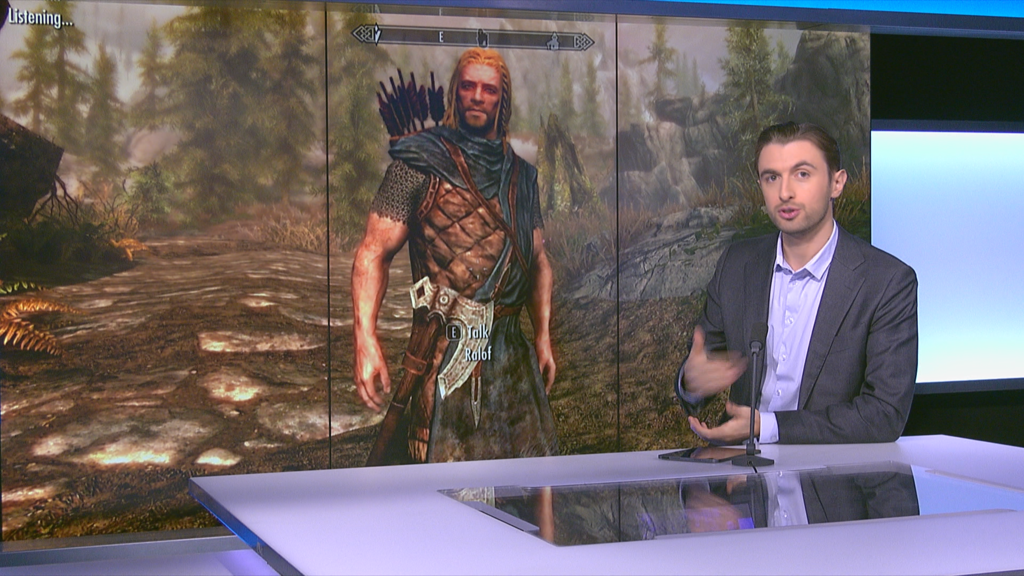
We’re used to video game characters repeating the same lines of scripted dialogue. But artificial intelligence is now allowing players to have unique, unscripted conversations with the characters they encounter. In Tech 24, explore this experimental tech and its path to the mainstream.
Hobbyists have turned classic games like “The Elder Scrolls: Skyrim and Fallout 4” into AI-powered playgrounds. Thanks to the downloadable mod Mantella, you can talk to non-playable characters (NPCs) using a microphone, and they’ll respond in character. This technology, powered by advanced AI models from companies like Google and Meta, opens up whole new ways to interact within games.
Some players find the experience so immersive that they develop deep connections. One forum user, for example, shared their experience with a Skyrim character named Uthgerd, claiming they even conceived a child together.
“We role played her water breaking and her giving birth which was wild … SkyrimVR is definitely therapy … when I play it I am instantly put in a good mood.”
We didn’t go quite that far when testing the mod on Tech 24, but we did have several conversations with NPCs that demonstrated the technology’s effectiveness. At times, it was difficult to distinguish AI-generated dialogue from the original game’s scripted lines. However, it required significant time and patience to get everything running smoothly; characters often misunderstood or responded with delays. For those willing to invest the effort and money, it’s easy to see how this could become a deeply engrossing experience. Paying for better AI models makes characters faster and more interactive, sometimes even recognizing their surroundings through computer vision. Downloading enhanced voice models can make them sound more natural. And using a virtual reality (VR) headset adds full immersion.
On YouTube, a creator known as “Brainfrog” shares videos of his adventures talking to AI NPCs in VR.
“You’re creating your own world with your own relationships and I found myself building genuine relationships with these characters,” said Eddie, “There are a substantial amount of issues and times where you run into this stuff and you’re just like, oh, I’m speaking to a dumb computer, but there are some moments that everything aligns and it’s really, really breathtaking.”
This technology is expanding beyond the modding community and moving into mainstream games sooner than many expect.
Just this week, developers for Meta’s Horizon Worlds VR platform were given access to tools that let them design AI-responsive characters.
Earlier this year, the hugely popular battle royale game Fortnite introduced an AI-voiced Darth Vader, which was wildly popular. Developer Epic Games has promised custom AI characters by the end of this year.
The next frontier is virtual characters that don’t just respond verbally but also interact physically with their environment. The Financial Times reported this Sunday that Elon Musk’s xAI is entering this race, competing with giants like Meta and Google, and poaching specialists from AI powerhouse Nvidia.
However, despite the enthusiasm from tech giants, many voices within the gaming industry remain cautious.
Michael Douse, head of publishing at Larian Studios – the developer behind “Baldur’s Gate 3” –stated this week that AI cannot solve the industry’s biggest challenge: “leadership and vision”.
“What this industry needs is not more mathematically produced, psychologically trained gameplay loops,” he posted on X, “Rather more expressions of worlds that folks are engaged with, or want to engage with.”
[ad_2]
Source link



