[ad_1]
Ahead of donning a beige WFP vest and boots to face hurricanes, wars and refugee camps, the Portuguese scientist worked with satellite imagery and cartography, creating maps to support humanitarian missions, until he realised he didn’t want to stay behind a computer screen.
On the occasion of World Humanitarian Day, marked annually on 19 August, Mr. Matos shared his story with UN News.
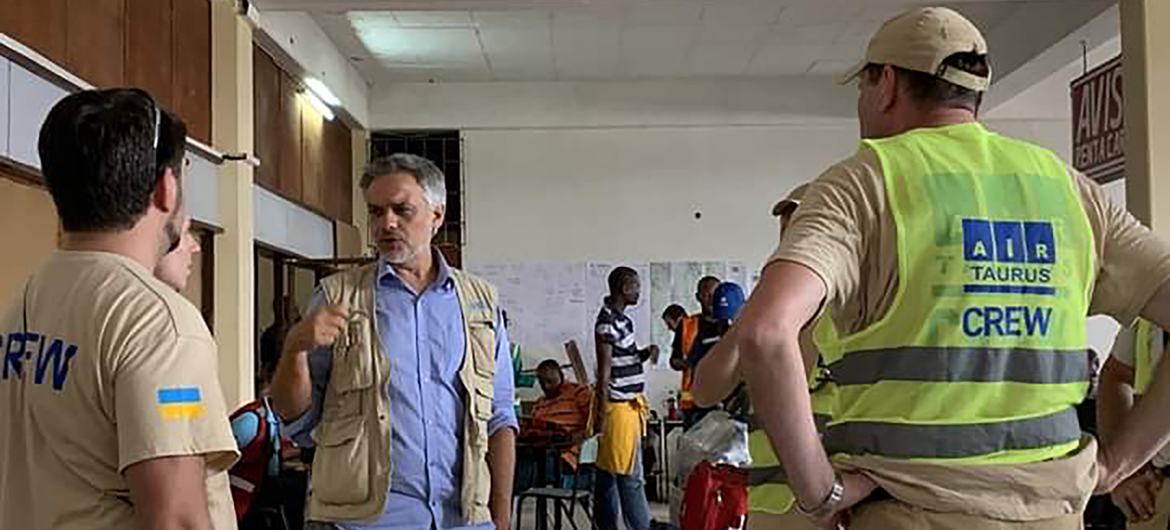
WFP/Marco Frattini
Pedro Matos joined the WFP response team following the deadly Cyclone Idai in Mozambique in 2019. (file)
From hurricanes to war
“At a certain point, it just wasn’t enough,” he recalled about his space engineering job. “I didn’t want to be making maps for other people to go and do humanitarian responses. I want to take those maps and be the one to do the responding.”
That’s exactly what he did. At WFP, he first developed maps on the ground and then went on to coordinate the agency’s emergency operations.
Since then, he has visited dozens of countries often at the epicentre of crises, from Hurricane Idai in Mozambique to the outbreak of war in Ukraine.
WFP/Michelle Sanson
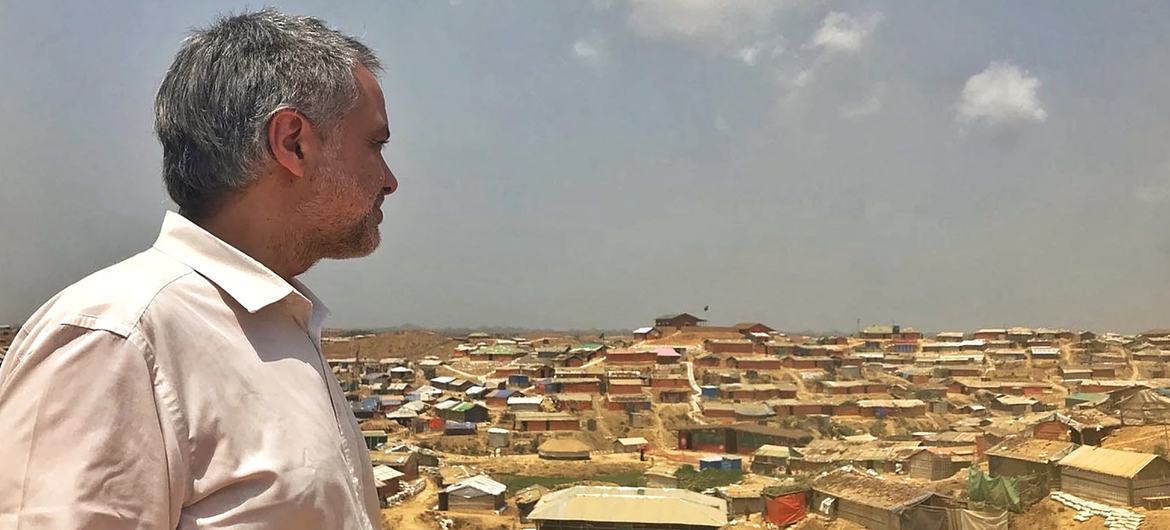
In 2018, Pedro Matos looks at the Kutupalong refugee camp where Rohingya refugees live. (file)
‘Like moving an entire government’
Coordinating in an emergency response is like “moving an entire government”, where each UN agency represents a “ministry” and the response only works when everyone comes together over the four essential areas in a crisis response: food, shelter, water and health.
Having just returned from a mission in Bangladesh, he described efforts to respond at Cox’s Bazar, the world’s largest refugee camp and home to 700,000 people who fled violence in Myanmar.
“We’ve been able to provide better conditions for people to live in this limbo with a little more comfort,” he said, also remembering his visit there in 2018 at the height of the crisis.
At the time, “a million people crossed the border in a month.” Today, although they remain in “limbo”, he pointed to improvements such as more monsoon-resistant homes and roads, gas stoves and reforestation.
Heart-shredding challenges and profound rewards
The job has meant both challenges and rewards.
“We’ve also had a few instances where we’ve been kidnapped, or come under fire, but it’s not the things that happen to us that impact us the most,” he said. “It’s the things that happen to others that have the most impact.”
Hurricane Idai in Mozambique was a Category 5 hurricane that hit Beira in 2019 was one of the biggest and most intense crisis, but also most rewarding, he said.
“There’s this mix of something that was very intense and hard because we couldn’t reach everyone, but at the same time, the fact was that there were many people – tens or hundreds of thousands of people – who would have died if we hadn’t been there,” he said. “That was the most impactful response in my 17 years at the United Nations.”
When he was in Yemen, “we were bombed 20 times a day” in the capital, Sana’a, he said, adding that “there’s a strange normalcy” that develops.
“We find ourselves saying things like, ‘no, that wasn’t very far; it was only 500 metres from here,’” he said. “It’s something I never thought I’d think or say before doing this work.”
When reaching central Ukraine several weeks after Russia’s full-scale invasion in early 2022, he called the situation “very intense”. Within a week, he and his colleagues began distributing money to people coming from the frontlines.
“When we interviewed people and asked them what they were doing with the money we gave them, it was very gratifying,” he said. “It was beautiful.”
Those who had been wounded in the war were using the money to buy painkillers. Others used it to pay for gas to escape the frontlines. One mother had been able to buy her daughter a scoop of ice cream for the first time since the war began.
“Her daughter was delighted,” he said. “There are very rewarding moments.”
Feeding millions every day
“We all think we know what the humanitarian or aid sector is,” Mr. Matos explained, adding that the scale during a crisis is much, much larger.
“I thought we’d be rehabilitating schools, feeding 100 people,” he continued. “I never imagined I’d be feeding 13 million people a day in Yemen. The scale is absolutely incredible.”
However, humanitarian work is often seen as a separate job, he said. Almost every profession that exists in private and government sectors also exists in an aid landscape, from lawyers, those who work in procurement, like in supermarkets, and human resources.
“I basically do the same work as social workers or firefighters,” he said. “They do it here every day, and I do it elsewhere. But, our work is in the same field and very similar.”
© WFP/Ahmed Basha
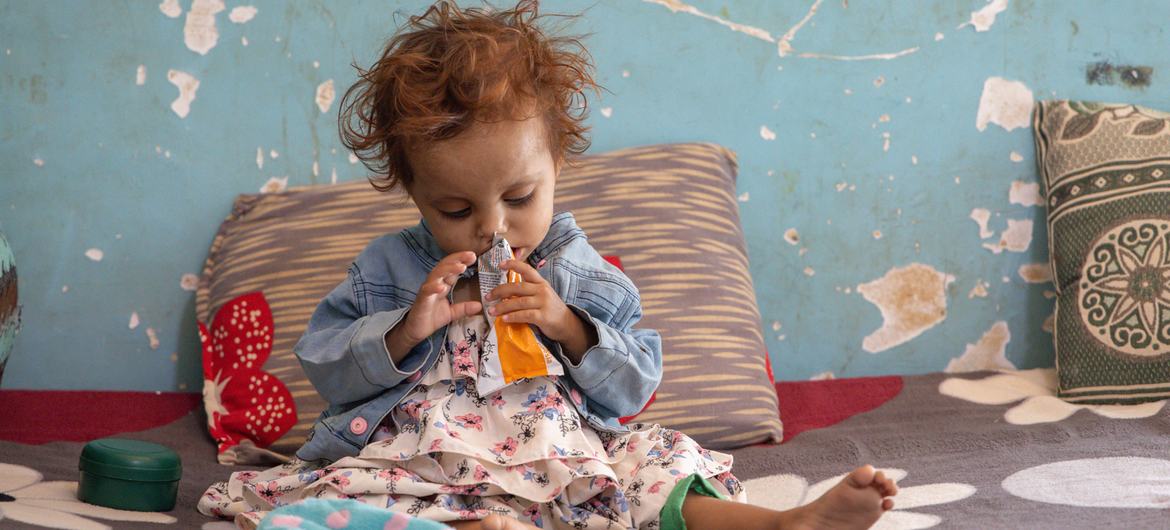
A toddler eats a food supplement, as part of WFP’s nutrition programme, in Mokha, Taiz, in Yemen.
The value of a Nobel Prize
WFP was awarded the Nobel Peace Prize in 2020, a recognition that Mr. Matos received with humility.
“Our work is largely invisible, despite feeding 120 million people every day,” he said. “It gave us a platform to raise awareness about crises like Congo, Myanmar, Sudan and Gaza, which often go unnoticed.”
He said his job is to give voice to the voiceless when crises fade from news headlines. Despite the difficulties and risks across his career, Mr. Matos has no doubt about the most important lesson he learned.
“People are essentially good,” he said. “When faced with the imminence of tragedy, people are fundamentally good and want to help others, even if that other person is very different. It was good to realise this because it’s not always obvious when we’re far from these crises.”
[ad_2]
Source link