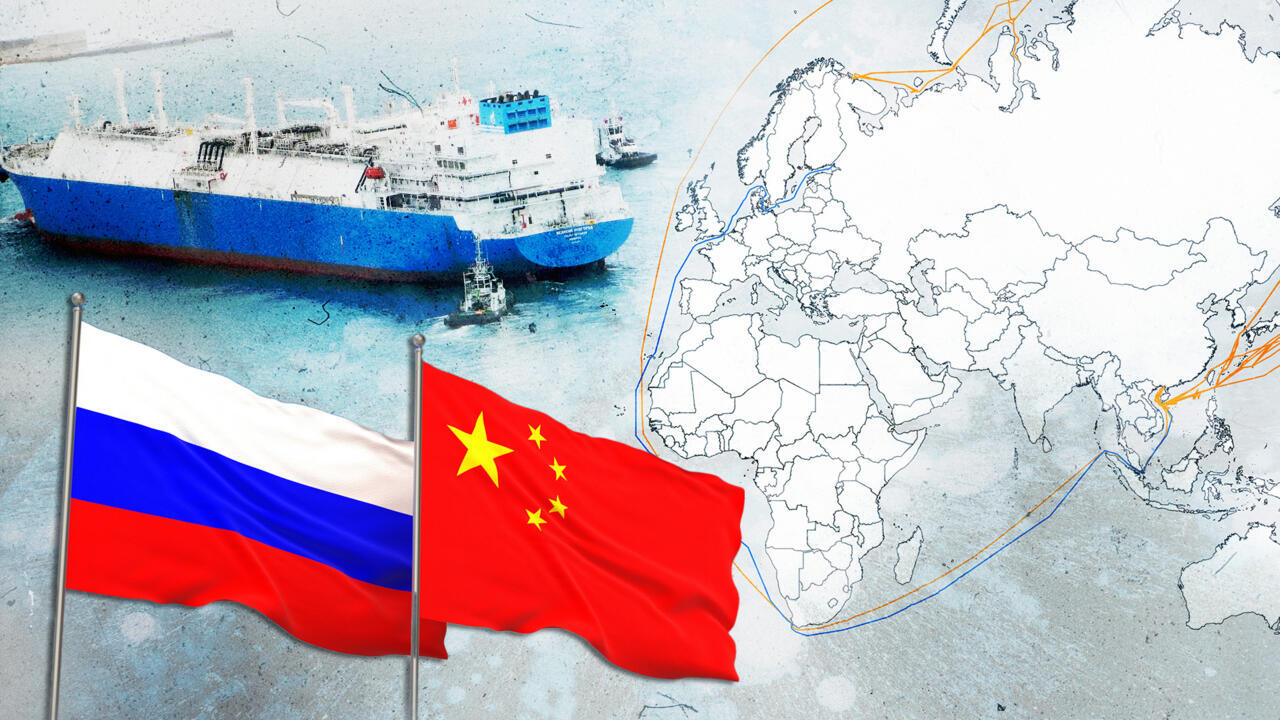
The vessel had been under intense scrutiny by industry analysts. On Monday, December 8, the Valera, a liquefied natural gas (LNG) carrier, arrived at the Beihai terminal in southeastern China.
This arrival was visible on public ship-tracking data and was confirmed by global real-time data and analytics provider Kpler. The LNG carrier was also observed in a satellite image provided by Planet Labs PBC, taken approximately one hour before its port arrival. It can then be seen heading toward the terminal, about 6 kilometres away.
The reason this LNG tanker was being closely tracked is that it was carrying LNG from Portovaya, a Russian LNG plant on the Baltic Sea operated by Russian energy giant Gazprom.
This is the first shipment exported by the plant to a foreign country since January 2025, when the Biden administration imposed sanctions on it. The Valera – which is sanctioned by both the United States and the European Union – unloaded nearly 160,000 tonnes of LNG, according to Kpler.
LNG, natural gas cooled to -160° to render it liquid for easier transport, is an integral part of Russia’s gas export strategy. The country, which produced 8 percent of the world’s LNG in 2022, plans to triple its output by 2030. However, as revenue from its sale – like that from oil and pipeline gas – helps fund the war in Ukraine, Western powers have sanctioned several of the facilities producing the gas and the vessels used to transport it.
Dark fleet to attempt LNG exports in 2024
Faced with sanctions, Russia attempted in 2024 to develop a “dark fleet” to export LNG, mirroring the tactic it employs for oil.
Specifically, it sought to export LNG from Arctic LNG 2, a plant in the Russian Arctic sanctioned by the US in late 2023. The facility, operated by one of Russia’s biggest producers, Novatek, is a key pillar of the country’s energy strategy and is expected to eventually produce 19.8 million tonnes of LNG annually.
In August 2024, the FRANCE 24 Observers team exposed how vessels were loading LNG from this plant while concealing their presence.
These LNG tankers were identified as falsifying their Automatic Identification System (AIS) data, which is intended to permanently report their location – a deceptive practice known as “spoofing”. Moreover, these ships were often linked to opaque companies registered in countries known for their lack of transparency, or were sailing under flags of convenience – practices frequently used by “dark fleets” to mask their true owners.
Read more‘Dark fleet’ suspected of transporting Russian liquefied natural gas from the Arctic
However, while several LNG tankers were loaded in 2024, none of them were able to sell their LNG at the time, according to online publication gCaptain. The cargoes remained in floating storage units or on LNG tankers immobilised at sea.
One million tons of sanctioned Russian LNG delivered to China
However, the situation changed in August 2025. As US President Donald Trump and Russian President Vladimir Putin met in Alaska for a summit dedicated to the war in Ukraine, several of these LNG tankers were spotted by analysts raising anchor or changing course. Thirteen days later, one of them discharged its cargo at China’s Beihai terminal.
In total, at least 18 LNG cargos from Arctic LNG 2 were delivered to the terminal in just over three months, between August 28 and December 9. Nine LNG carriers, all of which are subject to US or EU sanctions, were used for transport, allowing more than one million tons of the sanctioned LNG to reach China, according to Kpler.

How can we explain this change in policy from China, which previously only imported unsanctioned Russian LNG? Anne-Sophie Corbeau, a research scholar at the Centre on Global Energy Policy at Columbia University, explains:
“We simply have a new American administration. When Arctic LNG 2 started producing last year, the previous US administration was determined to prevent its ships from reaching their destinations. Now, we have a new president who seems friendlier toward Vladimir Putin. Until very recently, when there was some movement against oil companies, we hadn’t received many threatening signals directed at Russia. Thus, Russia and China essentially said, ‘We’ll give it a try.’”
‘They’ve come back from the darkness’
Not only are these Arctic LNG 2 deliveries taking place, but they are happening in plain sight. Ships that previously falsified their coordinates to load cargo from the facility in 2024 are now openly supplying Beihai with the LNG, with their AIS transponders switched on. All of them returned to the Russian flag over the past year and are now owned by Russian companies.
Kjell Eikland, managing director of Eikland Energy, an energy consultancy, told our team:
“They’ve come back from the darkness in a sense. Because they’re not afraid of sanctions and they also found that they will be found out eventually anyway. So there’s no point. The IT did not take many days before the LNG world was after them, looking for where the ships could be on satellite imagery.”

The Valera, for its part, sails under the Omani flag. The address associated with its manager in the Equasis database is in the United Arab Emirates and matches that of a hotel known to house Russian companies that manage shadow ships.
However, in the case of the recent December 8 delivery, the Valera made no effort to conceal its position, keeping its transponder active for almost the entire voyage. “It’s direct delivery to Beihai terminal, where Russia and China are no longer hiding on this movement,” Kpler said to our team.
“The transparency of the Valera delivery is a sign of further reduction in Chinese reservations to receive sanctioned Russian products,” Malte Humpert, an investigative journalist for the specialist publication gCaptain, also wrote in an article.
Russia may rely on a “shadow fleet” to move its oil, but establishing a comparable fleet for LNG is significantly more difficult. Firstly, monitoring is easier for analysts because LNG tankers are restricted to a limited number of liquefaction and regasification terminals. The same applies to the ships themselves: there are over 8,000 oil tankers worldwide compared to only 700 LNG carriers, as an analyst from the website Natural Gas World explained to our team.
‘Sending a message to the West’
In any case, the delivery of sanctioned Russian LNG sourced for the first time from a project other than Arctic LNG 2 “signals deeper China-Russia energy ties under sanctions”, says Kpler.
But why is this LNG so attractive to China? Humpert explained to our team:
“China gets up to [a] 40 percent discount. This is cheap LNG, while also sending a message to the US and the West that China does what China wants to, even in the face of sanctions. If working with Russia makes economic and geopolitical sense, China will do so.”
In fact, the first shipment of sanctioned Russian LNG to Beihai took place just days before Putin’s visit to China for the Shanghai Cooperation Organisation summit, where the two sides reached a deal to construct Power of Siberia 2, a giant pipeline that will link the two countries.
According to Corbeau, it is also a means for China to assert its independence from the world’s biggest LNG exporter, the US: “This is a signal China and Russia are sending to the US to tell them: ‘We might not need your LNG in the end.’”
‘They want to make a point’
For Russia, the interest is also political, Eikland said:
“They don’t really make any money. It is so much work to have to discount by 40%percent, with a very complicated delivery system. But they have considered it a sunk cost [Editor’s note: costs already invested in these projects]. And they have people staffing the ships and the plant; they can’t just shut it down.
But it’s symbolic, political. They want to make a point.”
The move could also be an attempt to anticipate forthcoming sanctions, as the EU decided on December 3, 2025, to ban all imports of Russian LNG by January 2027. “Europe is going to stop importing Russian LNG. This LNG will have to go somewhere,” Corbeau explained.
The researcher also points to the “geostrategic and geopolitical interest” that the “Northern Sea Route” – a route that connects Western Europe to Asia via the Arctic Ocean – represents for Russia. “These northern projects are absolutely essential. It is necessary to keep them open.”

‘Trump wants to avoid an escalation with China’
If China does not fear US sanctions, it is thanks in particular to the setup established to receive this LNG, explained Corbeau:
“They have taken a very specific terminal that is owned by a player who is not, a priori, exposed to US sanctions or to exchanges conducted in US dollars. And they have isolated it.”
Humpert agrees, believing the UK sanctions imposed in October on this terminal – which now only receives Russian cargo – are unlikely to be effective.
Corbeau argues, however, that it could be possible to exert leverage on China, specifically “by sanctioning the company behind the terminal, increasing tariff pressure, or identifying who is consuming this LNG and whether they could be subject to sanctions.”
However, she suggests Washington may not desire this outcome. “I think President Trump wants to avoid an escalation with China. Beijing has the ability to retaliate with measures concerning critical minerals.”
On November 24, four US Democratic senators denounced the “lax enforcement by the Trump administration of sanctions on Russia’s Arctic LNG 2 export terminal”. “LNG from Arctic LNG 2 is an energy revenue stream worth billions for Putin’s war machine,” Democratic Senator Elizabeth Warren stated.
Chinese dark fleet?
While many Russian cargoes were delivered openly, some recent events, however, remain shrouded in mystery.
Three months before the Valera, another tanker linked to Portovaya and also sanctioned by the United States, the Perle, departed the plant loaded and headed for Asia. More than three months later, on October 18, it was identified off the coast of Malaysia alongside another LNG tanker, the CCH GAS, which was engaged in “spoofing”. The two tankers were performing a ship-to-ship transfer, a practice commonly used by dark fleets to transship cargoes on the high seas, conceal their origin, and thereby circumvent sanctions.

The CCH Gas – which has not reported its location since the transfer – was subsequently identified by analysts as a potential member of an emerging Chinese dark fleet. This fleet is suspected of being used by Gazprom to secretly ship Portovaya LNG. Humpert further suggests this nascent fleet could also be an attempt to anticipate future European sanctions against the Yamal LNG megaproject, which currently supplies Europe with LNG.
With its AIS signal disabled, its recent purchase by “Chinese interests”, and its use of a flag of convenience, the CCH Gas fits the profile of a dark ship. The vessel was observed near Hong Kong on December 8, and, according to Eikland, all indicators point to it still carrying the sanctioned LNG cargo from Portovaya.