Article content
The swan came into Chantal Theijn’s wildlife rehabilitation centre with a broken beak.
Advertisement 2
Article content
But the founder of Hobbitstee Wildlife Refuge in Nanticoke could tell something else was seriously wrong.
Article content
Recommended Videos
Article content
The stately white bird was spotted by the lakeshore in Burlington and brought to the Haldimand County animal hospital by one of Hobbitstee’s small army of volunteer drivers, who criss-cross southern Ontario responding to all manner of wildlife distress calls.
The injured swan got to Hobbitstee on Dec. 6, during an open house that gave the public a rare look inside the registered charity’s new treatment and research facility.
Theijn, a trained veterinary technician who founded Hobbitstee in 2007, stepped away from her hosting duties to evaluate her newest patient.
“It was quite obvious to me when the swan arrived that there was a lot more going on,” she told The Spectator.
Advertisement 3
Article content
The bird was weak, had little muscle mass and was “barely able to stand,” she recalled.
A blood test confirmed her suspicions — this swan was suffering from lead poisoning.
An X-ray revealed pieces of fishing tackle in the swan’s stomach, including a lead pellet.
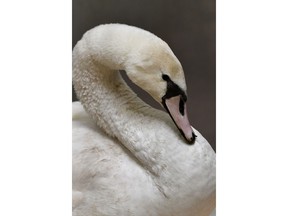
Swans are at high risk for lead poisoning because they are bottom feeders who indiscriminately forage for whatever has sunk to the lake floor, Theijn explained. And even though lead ammunition for hunting waterfowl has been banned for some 25 years in Canada, lead still litters local waterways.
“Every bit of lead shot has sunk to the bottom, and it’s there,” Theijn said. “It never disappears, it doesn’t dissolve. It just stays there until it gets ingested by an animal.”
Advertisement 4
Article content
Compounding the problem is lead runoff from long-shuttered industries that polluted Lake Ontario, where this swan likely foraged for food.
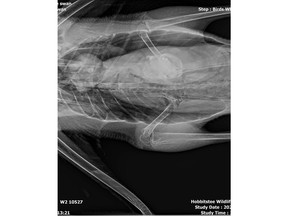
With the poison seeping into the swan’s body, Theijn brought the injured bird to Hobbitstee’s go-to veterinarian, Dr. Shannon Lee at Scott Veterinary Clinic in Brantford. There, the swan was prepped for surgery.
Theijn likened the challenge of finding the lead pellet in the swan’s innards to “searching for a needle in a haystack,” even with the help of a flexible scope affixed with a grasping tool.
“We found all the other pieces, but we could not locate the lead in the first session,” said Theijn, who assisted Lee’s team during the two-hour operation.
It is too dangerous to keep a swan sedated for longer than two hours, so a second surgery was needed.
Advertisement 5
Article content
“So we gave it a day or so and tried again. And just as we were about to give up, Dr. Lee spotted the lead,” Theijn said.
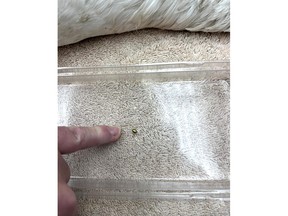
“We were all really, really tense because when you grasp something with one of these tiny graspers, sometimes it slips out. But we managed to remove the lead, so that was quite the victory dance we all did.”
This swan may not have been out a-swimming on the seventh day of Christmas, but once he is fully recovered, Theijn said he will be returned to the wild.
‘Just hanging out’ for the winter
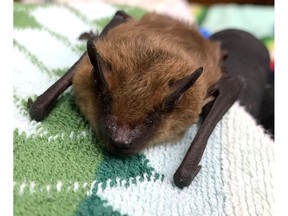
The swan is one of about 80 animals currently being cared for at Hobbitstee. The majority are bats hibernating for the winter.
“They’re literally just hanging out,” Theijn said.
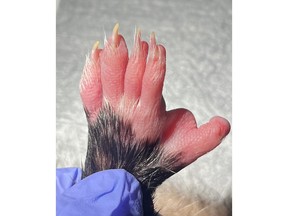
A frostbitten female opossum requires more attention.
Advertisement 6
Article content
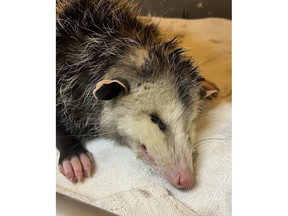
The omnivorous scavengers typically stay in their dens during cold spells, but as they do not hibernate, opossums must eventually venture out in search of food.
“At some point they get so hungry, they have to choose between freezing their paws off or starving to death,” Theijn explained.
Unlike their furry fellow scavenger, the raccoon, an opossum’s ears, tail, nose and feet are hairless and prone to frostbite.
Theijn suspects her opossum patient was displaced from her den and left out in the cold. Now safe and warm inside an incubator at Hobbitstee, her toes and tail are slowly healing.
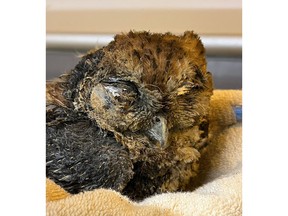
Intense cold felled the opossum, but it was a blast of heat that brought a screech owl to Hobbitstee in November with burns to its feathers.
Advertisement 7
Article content
The bird was nestled inside a wood stove when the homeowner inadvertently lit it, not realizing the stove had a tenant. The homeowner heard the banging sound of the panicked owl trying to escape the flames and quickly bundled the tiny burn victim off to Hobbitstee.
“He’s coming along OK,” Theijn said, predicting the little bird will need “a year or more” to recover from his burns and regrow his primary flight feathers, which “melted” in the heat.
His plumage was singed but protected his skin from being burned, and fortunately, the flames did not damage his eyes, she added.
Once the owl has undergone a few moults and regrows his flight feathers, he will be moved to an outdoor enclosure to get used to flying again.
Helping thousands of animals, free of charge
Theijn works alone during the winter months at the facility just north of Lake Erie, but she said caring for 80 patients at once is “not a huge number.”
Advertisement 8
Article content
“In the summer we get inundated with orphaned babies, and they are a lot of work,” she said.
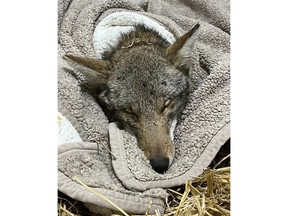
Hobbitstee helped 3,452 sick, injured, orphaned or displaced wildlife over the past year, from turtles, toads and bunnies to foxes, coyotes and porcupines, with a long-tailed weasel and ruffed grouse among recent patients.
All services are provided for free by volunteers, and the goal is to get all animals back to their wild homes once it is safe to do so. Cameras inside each enclosure allow Theijn to monitor the animals without exposing them to constant human interaction, which would harm their chances at successfully returning to nature.
The registered charity’s work is licensed by Canadian Wildlife Service and the Ontario Ministry of Natural Resources, but Hobbitstee receives no government funding, instead depending on grants and donations.
Advertisement 9
Article content
A recent Giving Tuesday campaign brought in $63,465, thanks in large part to a generous donor who matched the first $30,000 raised.
Theijn said that “absolutely amazing” amount will cover the charity’s utility bills, insurance and other overhead costs for a full year, and help pay for animal feed, bedding and veterinary costs.
“We’re a smaller charity, so maybe that doesn’t sound like a whole lot,” she said. “But for us, it takes a lot of pressure off to have that kind of money in the bank so I know we can pay our bills for the next year.”
‘Lucky break’ for displaced Hamilton snakes
Hobbitstee is a partner organization with City of Hamilton Animal Services, meaning plenty of displaced wildlife from Hamilton end up at the Nanticoke animal hospital.
Advertisement 10
Article content
Among Hobbitstee’s Hamiltonian patients this year were an eagle with an injured wing, coyotes contending with puncture wounds and mange, and bats removed from city homes and released by public health after being tested for rabies.
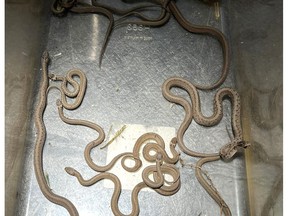
A group of DeKay’s brownsnakes slithered into Hobbitstee in October after being evicted from a Hamilton construction site.
“It was totally accidental. Nobody knew there was a snake hibernaculum there,” Theijn said, describing how construction work destroyed the snakes’ overwinter home.
“A construction worker on-site realized what was happening, so he ran around like mad and scooped up as many snakes as he could find.”
The worker called Hamilton Animal Services, which got the 17 surviving snakes to Hobbitstee, where they will spend the winter before returning to the wild once the weather warms.
Advertisement 11
Article content
“It was a lucky break,” Theijn said. “Had he not been there, those snakes would have probably all perished.”
‘This is what I love’
Theijn said she rarely leaves the animal hospital over the fall and winter. There are too many animals to care for, and too much administrative work needed to keep the charity going.
“What drives my work is this is what I’m passionate about,” she said.
“This is what I love. It’s never boring.”
Theijn and her team conduct research into emerging diseases and collect data for projects aimed at reducing wildlife mortality on roadways. Hobbitstee also offers educational seminars and advocates for habitat conservation.
“But also just getting these individual animals back into the wild,” Theijn said before going back to check on the mute swan’s post-op progress.
“There’s no better feeling than releasing an animal after it’s come in injured or sick. Once this swan is recovered, it’ll be so lovely to see him go on and have a normal life.”
J.P. Antonacci is a Local Journalism Initiative Reporter based at the Hamilton Spectator. The initiative is funded by the Government of Canada.
Article content